
About Us
ADIMANTAR RURAL & TRIBAL DEVELOPMENT FOUNDATIONWelcome To
ADIMANTAR RURAL & TRIBAL DEVELOPMENT FOUNDATION
Adimantar rural and tribal development foundation is a grassroots organisation born of founder Tarun Pant’s vision of community development and a revitalised local handicrafts sector. Driven by a desire to give back to society Mr Pant bid adieu to a successful corporate career in 2017 and retraced his steps to native Uttarakhand. From here he began the journey which took him across several Indian states until he zeroed in on the Tharu, Moonj grass weavers of Khatima and Sitarganj in home state Uttarakhand. Grass weaving had always been an integral part of Tharu culture but sadly it was now a dying craft, the new generation did not find it lucrative enough to pursue.
Tarun Pant saw here the opportunity not only to preserve local cultural tradition but also to economically empower the tribal artisan. Through partnership with local communities a system of support was built up for the artisans who were mostly women. Expert NIFT trained designers were roped in for aiding design development and under their guidance a pioneer batch of 20 Tharu women weavers were trained to create products that were demand oriented and consequently commercially attractive as well. This group of 20 in turn trained many more,thus creating a network that could sustain rural livelihood as well as preserve traditional crafts.
Then the pandemic struck, but despite the challenges the initiative was continued. Villagers of Udham Singh Nagar were trained in garment stitching so as to ensure financial stability in the troubled times. Well known brands like Patanjali, Om logistics Ltd, NECC Ltd. also stepped in to help.
The number of Tharu women involved grew exponentially, from 20 to 2000 within two years. Currently 3000 of them are in the loop, earning anywhere between ₹10-₹15,000 per month. Their products have reached national as well as international markets, not only making them self reliant but also attracting the youth to their traditional craft.
The goal is to reach the count of 20,000 in years to come, a network of 20,000 skilled artisans who will contribute significantly to a self reliant India.
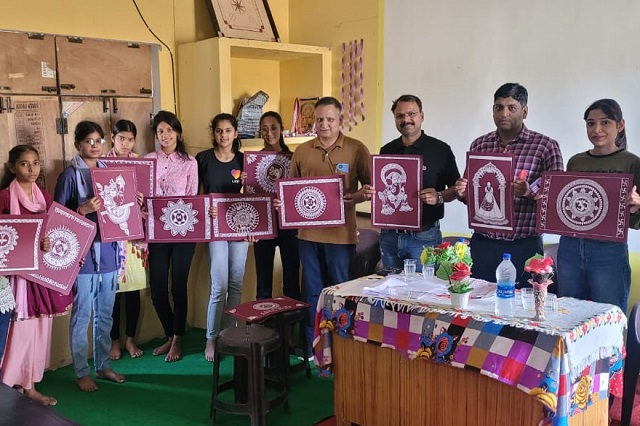
Traditional Aipan art of Uttarakhand and bamboo craft involving eco-friendly products such as furniture have also been encouraged and supported by Adimantar apart from Moonj weaving and garment stitching.The village folk receiving adequate training and market access for their finished products.
Mission
Entrepreneurship training programmes and skill development workshops are routinely organised by the foundation for rural artisans where they are introduced to the latest trends and innovations in their field.
By enabling easy market access we help the rural, tribal entrepreneur to scale business and enhance economic prospects.
At Adimantar we are committed to fostering sustainable practises throughout the production process constantly emphasising, ethical sourcing, fair trade, principles, and environment friendly techniques to ensure that our impact is both positive and lasting.
Vision
ADIMANTAR envisions revitalizing the fading arts and crafts of rural tribes. We aim to empower communities by preserving their cultural heritage, fostering economic opportunities, and ensuring the transmission of traditional skills to future generations.Thus creating a flourishing rural India.
Objectives
Economic Empowerment:
- Facilitate skill development and entrepreneurship training programs to empower individuals, especially women, to generate sustainable livelihoods.
- Promote income-generating activities such as agriculture, handicrafts, and cottage industries to create employment opportunities and reduce poverty levels.
- Provide access to financial services, microcredit, and market linkages to enable rural and tribal entrepreneurs to scale their businesses and enhance their economic prospects.
Social Inclusion and Empowerment:
Promote gender equality and social justice by empowering women and marginalized groups to participate in decision-making processes at the community level
Environmental Sustainability:
- Advocate for sustainable natural resource management practices that respect the ecological integrity of rural and tribal areas.
- Implement conservation and reforestation projects to protect biodiversity, mitigate climate change, and enhance the resilience of ecosystems.
- Promote awareness and education on environmental conservation and sustainable agriculture practices to empower communities to become stewards of their natural environment.
Infrastructure Development:
- Improve access to essential infrastructure such as roads, electricity, clean water, and sanitation facilities to enhance the quality of life and facilitate economic development in rural and tribal areas.
- Invest in the development of educational and vocational training to equip youth with the skills and knowledge needed to succeed in the modern economy.